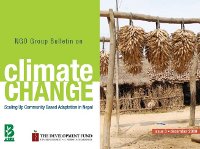
LI-BIRD has published climate change bulletin (3rd issue) in December 2009. The editorial, contents and free pdf copy of this publication are as presented below:
Editorial
 Nepal is a mountainous country with great variation in topography and microclimate. The fragile geo-physical and delicate socio-economic settings make Nepal most vulnerable to the impacts of climate change. The average annual temperature rise in Nepal is 0.06 degree C. Nepal shares only 0.025% of global greenhouse gas emission. But Nepal is facing adverse impacts of climate change. These impacts are increasingly evident in agriculture, forests, wetlands, biodiversity, infrastructure and human health. Developed industrial nations are responsible for carbon emission than the developing nations like Nepal. A global incentive mechanism is essential between developed and developing nations. The developed nations should commit for legally binding green house gas emission cuts and ensure flow of financial incentives to developing nations to assist in adaptation and mitigation actions.
The international negotiations on climate change (UNFCCC COP15) wrapped up on December 19, 2025 in Copenhagen with disappointing note. The Copenhagen Climate Summit achieved an interim agreement, known as the Copenhagen Accord to be decided to adopt in 2010. In terms of substance the Copenhagen Accord immediately faced strong criticism as it did not include clear text on emission reduction targets by the developed nations. However, this accord brings yet another chance for the major greenhouse gas emitting countries to commit on reducing emission and ensure adequate and predictable finance to developing nations.
Nepal has taken some important initiatives for addressing climate change issues. The National Climate Change Policy draft is out for review. The National Adaptation Programme of Action and Second National Communication Report to United Nation Framework Convention on Climate Change are under preparation. In Nepal, actions on climate change issues are yet to be emerged holistically. There is ample scope of building knowledge base, promoting adaptation measures and raising awareness on climate change issues. In this context, we are pleased to publish third issue of climate change bulletin entitled ‘NGO Group Bulletin on Climate Change’ as a tool for sharing knowledge & information on community based adaptation, and raising public awareness on climate change issues. The first issue of the bulletin entitled ‘Up in Smoke – Nepal’ was published in 2007 and the second issue entitled ‘Melting Glaciers’ in 2008.
This third issue covers the basics and practical cases of climate change impacts and communitybased adaptation in Nepal. Gehendra Gurung summarizes the climate change and disaster ssues and priority actions for Nepal. Gandhiv Kafle and co-authors describe how Ecohealth approach is contributing to reduce climate risks and vulnerabilities in chepang community of Nepal. Dinanath Bhandari describes the climate change, observed hazards, future vulnerability and some adaptation strategies emphasizing the need for increasing resilience capacity of the local communities amidst multiple climate hazards. Rajan Ghimire with co-author describe the importance of conservation agriculture to climate change adaptation describing some feasible practices for Nepal. Sunil Babu Pant presents a simple case study of an elderly woman emphasizing the need for preparing for the worst of climate change by the present and future generations i.e. climate generations. Ek Raj Sigdel describes the impacts of floods on livelihood of local community and possible preventive and protective measures in a Terai district of Nepal. Keshab Thapa describes the importance of sustainable agriculture to agro-ecosystem resiliency against climate stress. At the end, Apar Paudyal has highlighted update on NGO group on climate change movement in Nepal and its focus and strategies in the future. A glimpse of activity news related to the climate change is also presented.
We will be pleased to receive your feedbacks, which will be useful for enhancing next issue.
Happy reading!
Contents:
1 Editorial
2 Climate Change: Nepal’s Priorities for Action
6 Piloting EcoHealth Approach for Addressing Land Use Transition, Climate Change and Human Health Issues
11 News and Events 1
12 Adaptation to Climate Change: Improving Livelihoods Amidst Multiple Hazards
17 News and Events 2
18 Conservation Agriculture Rally Rounds Adaptation to Climate Change
23 News and Events 3
24 Climate Generations
27 News and Events 4
28 Flood Impact on Livelihood of Local Community in Far West Nepal
32 Climate Change Adaptation in Agriculture: The Sustainable Way in Nepalese Context
37 Scaling up NGO Networking on Climate Change in Nepal
| Attachment | Size |
|---|---|
| Final_Climate_Change_Bulletin_2009_eCopy.pdf | 2.16 MB |
