
Zygogramma bicolorata, a Mexican beetle...
09Feb

The rapid expansion of parthenium weed has rapidly become a new environmental problem in urban and peri-urban areas of Nepal, particularly in the southern tarai plains and the middle hilly region. Although the plant was first known to the scientific community of Nepal in the 1960s, population increases of this weed did not occur until the 1990s. It is interesting to note that farmers of Hetaunda (a city in Churia region which is about 50 km north from the Nepal-Indian border) noticed this weed in their pasture land (Lamsure danda) in 1990 when there was restoration of the multiparty system in Nepal. Then the local people called this weed 'Bahudal Jhar', literally meaning 'Multiparty weed'. From the current distribution pattern of this weed in Nepal, it is evident that parthenium weed entered Nepal from the south. Due to the open border and direct road connection, thousands of the vehicles cross the Nepal-India border every day and at several places. Through any of these road networks, parthenium weed might have entered Nepal early from India, where the weed was first reported in 1814.
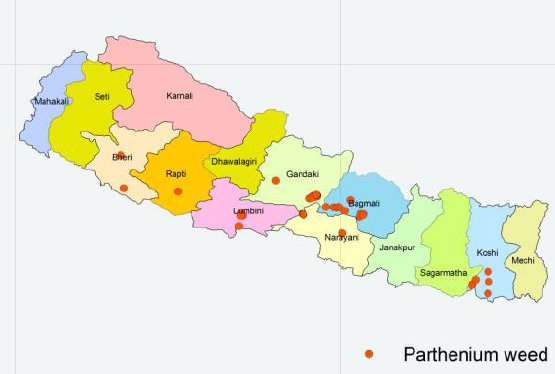
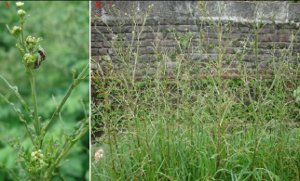
A reconnaissance of the distribution of parthenium weed in Nepal revealed that this weed is expanding along the road network in the country. Physiographically, Nepal can be divided into three horizontal (east-west) zones: tarai plains in the south, the mid hills in the centre, and the high mountains on the north. From the tarai plains, the weed is expanding to the mid hills through the road network and transportation of agriculture products. The weed has been observed up to 1,400 m asl (Kathmandu valley). In peri-urban areas, this weed is mainly found in grasslands and abandoned agriculture lands. It has been found less frequently in cultivated agriculture lands. However, once the agriculture land is abandoned for 1-2 years, parthenium weed becomes a dominant weed. In most of the places, invasion is considered to be at the 'colonization' stage and stem density has reached up to 402 stem m-2.
Currently parthenium weed is a dominant species in the grasslands, fallow lands and roadside vegetation of several major urban areas in Nepal including Kathmandu (the capital city), Hetaunda, Narayangargh, Butwal, Pokhara, Dang, Surkhet, etc. So far a Nationwide survey of the area invaded by this weed is lacking, however, by a joint effort of Bharat Babu Shrestha from Central Department of Botany, Tribhuvan University, Nepal, and Asad Shabbir from Tropical and Sub-Tropical Weed Research Unit, University of Queensland, Australia, a preliminary map of distribution of parthenium weed in Nepal has been prepared.
 |
Zygogramma bicolorata in Nepal
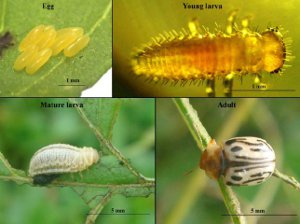
There is no official record of deliberate introduction of Zygogramma bicolorata Pallister (Coleoptera: Chrysomelidae) into Nepal. However in August 2009, defoliation of parthenium weed by Z. bicolorata was observed at Hetaunda (Makawanpur district, central Nepal). By the end of September 2009, more than 80% of the Parthenium infested sites at Hetaunda showed heavy defoliation by the beetle. Similar defoliation, but less extensive in area and level of defoliation, was also observed in Bharatpur (Chitwan district), Gaindakot (Nawalparasi district), Butwal and Bhairahawa (Rupandehi district).
 |
In August 2009, a detailed survey was carried out in the Kathmandu valley (covering three cities Kathmandu, Patan and Bhaktapur) to prepare distribution map of parthenium weed and to observe possible defoliation by the beetle. Though parthenium weed was the dominant weed in grassland, fallow lands and roadside vegetation throughout the valley, defoliation was not observed and beetle was not found. Surprisingly, a small population of this beetle was encountered in the grassland at Kirtipur (Kathmandu Valley) alongside the Hetaunda-Kathmandu highway (via Kulekhani) in October 2010. However, the defoliation of weed was not appreciable at this site.
From this highway nearly 200 vehicles from Hetaunda enter Kathmandu valley every day. It appears that the beetle was carried to the Kathmandu Valley from Hetaunda by these vehicles. Presence of high hills (>2000 m asl) and absence of parthenium weed in the areas between Hetaunda and Kathmandu ruled out the natural dispersal of this beetle to Kathmandu. Similarly, in October 2010 a small population of this beetle without appreciable defoliation of parthenium weed, was also observed in Dhading Bensi (Dhading district).
 |
The above reports indicate that Z. bicolorata has become established in Nepal, and has become an interesting phenomenon of „fortuitous biological control‟. Due to the presence of an open border, ecosystem corridors, direct road connection, and free vehicular movement between Nepal and India, it is almost certain that the beetle has entered Nepal from India in the same way as parthenium weed has done. Since defoliation of the weed in Hetaunda (about 50 km north from Nepal-India border) was not seen in 2008, but was seen in 2009, a conservative estimate based on the reports from India and Australia has led to the conclusion that the beetle has entered Nepal recently, between 2004 and 2006.
Host range expansion of Z. bicolorata has not been observed in Nepal. However, larva and adults of this beetle do feed on the leaves of another invasive species Xanthium strumarium and this was observed in Butwal.
(This article was published in International Parthenium News, No. 3, January 2011. For more information about parthenium, visit http://www.weeds.org.au/WoNS/parthenium/resources.htm)
| Attachment | Size |
|---|---|
 Parthenium News Jan 2011.pdf Parthenium News Jan 2011.pdf | 335.1 KB |
Tags:
Category: