The Hills Leasehold Forestry and Forage Development Project had a total projected cost of USD 20.4 million, to be financed by an IFAD loan of USD 12.8m, a USD 3.4 million grant from the Royal Netherlands Government for the Technical Assistance component implemented by FAO, and contributions of USD 2.7 million and USD 1.5 million from the HMG/N and participant-farmers respectively. The amount of the IFAD loan has twice been reduced, most recently to around USD 6 million. HMG/N cut its contribution by 50 percent due to additional security expenses during the insurgency. The Dutch-funded TA grant eventually totalled USD 4.85 million spread over two phases. Project implementation effectively got underway in 1993, and the project is due to close in December 2003.
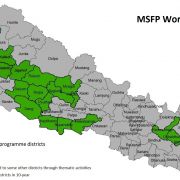
Project activities up to 1995 were confined to four districts, then progressively extended to a further six. The amended project target was the formation of 2,040 leasehold groups of 14,600 poor households and the rehabilitation of 13,000 hectares of degraded forestland. The basic criteria for group membership were land ownership of less than 0.5 ha and an annual income below the poverty line, with a degree of flexibility permitted. Positive discrimination was urged towards landless and near-landless groups, disadvantaged tribal groupings, and female-headed households.
Objectives:
The HLFFDP is an innovative project, given the lack of precedents in Nepal and the project’s commitment to the direct transfer of assets to the poor. The project combines the objectives of raising the living standards of the poor and regenerating degraded forestland. The rationale of the project was based on solving the problem of common access to forest by leasing users’ rights over plots of degraded forest to groups of five to ten poor households, who were to be in charge of their rehabilitation and entitled to the use of forest products. The lease is renewable after forty years.
Forest rehabilitation was to be achieved principally by a ban on grazing in the leasehold sites. Income generation for participating households was to be achieved by increasing the supply of fodder and forage for livestock and the provision of income-earning possibilities from livestock and other sources. A further objective was the empowerment of the communities concerned through the formation and training of groups, the mobilisation of savings and access to credit. The major inputs were the provision of subsidised high-yield grasses and fodder tree seedlings, improved breeds of animal, strengthened veterinary services, appropriate training programmes, and subsidised agricultural credit.
| Attachment | Size |
|---|---|
 IFAD_Evaluation_2003.pdf IFAD_Evaluation_2003.pdf | 1.26 MB |
| profile.pdf | 433.12 KB |