
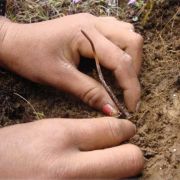
Ophiocordyceps sinensis known as...
Although Nepal has met with a fair amount of success in conserving biodiversity with the establishment of the Protected Area system (there are 16 Protected Areas in total in the country), balancing conservation and human needs still remains a major challenge. The Buffer Zone programme was initiated to address this challenge. For this, the Department of National Parks and Wildlife Conservation (DNPWC) under the Ministry of Forests and Soil Conservation (MFSC) piloted the programme through the Park People Programme (PPP) with the technical and financial support of UNDP from 1995-2001. The Participatory Conservation Programme (PCP), implemented since May 2002, is a follow-up to PPP to institutionalize its achievements. The goal of this integrated initiative is to bring about biodiversity conservation with the active support and participation of the Buffer Zone communities (people living in the areas surrounding with in 7- National Parks and Wildlife Reserves) and, at the same time, bring about their socio-economic development. The programme coverage presently encompasses all the PCP working area VDCs (122) in all 20 programme districts. PCP's intervention is benefiting more than 90,849 households and a population of almost 600,000 people.
Objectives:
The goal of this integrated initiative is to bring about biodiversity conservation with the support and participation of the local communities living in the areas surrounding National Parks and Wildlife Reserves (Buffer Zones) while simultaneously encouraging development programmes for improving their livelihoods.
The overall objective of the PCP is to conserve biodiversity in and around the targeted Parks/Reserves through community mobilization and programmes that support community forestry, alternative fuel usage, capacity building and institutionalization of the various community based organizations. This is aimed at helping to reduce the dependency of the BZ communities on the natural resources of the Parks/Reserves and their Buffer Zones. Communities are also being trained in the management of eco-tourism activities. The mitigation of the Park-people conflict is, therefore, an integral part of the PCP programme design.
Contact Address:
Mr. Top B. Khatri
National Programme Manager
Participatory Conservation Programme P.O. Box 15113 Babarmahal, Kathmandu Nepal
Tel: 977-1-422 2348, 424 7056
Fax: 977-1-424 7056
Email: [email protected]
Project Website:
www.undp.org.np
