

Natural rubber is one of the most...
20May
Natural rubber was first introduced to Singapore in 1877 and then it became commercial planting material in Malaysia which was originated from 22 seedlings. Today, rubber industry is the second largest industry in the world after iron and steel. It is one of the most important raw materials that is important for transportation, industry, defense and medical field, and used for manufacture of more than 40,000 products including 400 medical devices. According to the International Rubber Research and Development Board, Malaysia, about 20 million people directly depend on rubber as their primary source of income. One billion cars, trucks, airplanes on the planet’s roads are all dependent on them. It is a green material for the current era. Based on 22 years research study of Gorakhkali Rubber Industry Ltd. with the joint venture, Sudha Falrus Pvt. Ltd, Sanischare-1, Jhapa set up a Pioneer Pilot Project in 1989. 15 years of yield performance show that Hevea cultivation is highly potential in Eastern Terai districts of Jhapa, Morang, Sunsari and lower parts of Ilam. Currently, an estimated 500 hectares of rubber farming is booming in these districts.
Sanischare-1, Jhapa Farm
The production so far is 200 ton per year while consumption is 12,000 metric ton (US $ 45 million or 3 Arab NRs. per year and rubber related products) in Nepal. It has been estimated that by 2020 AD, the demand of Natural Rubber is expected to cross 20,000 metric ton per year.
Rubber planting was introduced in the early 1970s but never achieved a great success. The current boom in rubber is being fueled by a demand from rubber market, particularly Gorakhkali Rubber Udyog Ltd, individual farmers interest, private companies, cooperatives and local forestry user groups. The IRJR-Nepal (www.irjr-n.org) has targeted 15,000 hectares of rubber plantation by 2023 with close coordination and partnership of Government of Nepal, local stakeholders and multinational agencies. Nepal holds 44th position in natural rubber farming among other countries. Gorakhkali Rubber Udyog Ltd. is a major industry and buyer of raw materials which has a capacity of 120,000 automobile tyre and tube production per year. There are more than 3 dozen medium and small factories and 300 tyre resoling centers all over Nepal.
Natural Rubber is multi products industrial cash crop which is obtained from the latex of Hevea brasiliensis, a native of Brazil. It has gestation period of 6-7 years; economic life around 25 yrs and its potential areas include 15,000 hectares in Jhapa, Morang, Sunsari and Ilam districts. It yields per hectare 1750 kilograms (3 to 4 lakh net profit per hectare per year). Due to its valuable properties, natural rubber is considered “White Gold”. Its current international market price is around average 3.5 to 4.0 dollars per kg of process rubber. Rubber latex can be processed in a small machinery, which cost NRs 30,000 which can cover 50 hectare of produce areas.Therefore, Dr. Romalo L. Cena, Director of the Philippines Industrial Crop Institute said, “The rubber tree is a bank, every drop is money”.
Why natural rubber farming in Nepal?
There are several important reasons that include huge industrial demand, long period of productivity, high volume of tropical rubber wood, high cost of synthetic rubber, low investment and it has a wide range of adaptability. It provides high and regular income to the farmers, generates stable rural employment, allows intercropping of food and cash crops for higher farmers income. Its plantation labor cost in Nepal is cheaper than the emerging Asia. As of 2010, 1.3 million automobile vehicles are running in Nepal’s road. Moreover, Nepal will benefit from adhering of new technology and carbon trading.
Benefits of Rubber Planting in Nepal
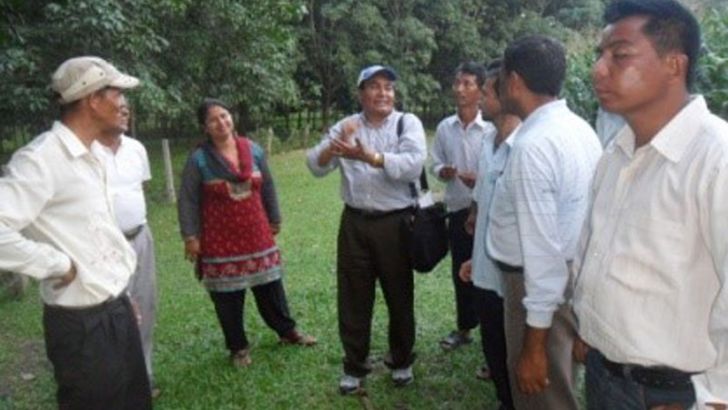
Mr. Bhandari advising to farmers
Production of dry rubber 25,000 Mt ton/ha/ annum equivalent $100 million (Rs. 8 Arab). Nepal can develop gainful self-employment (25,000 persons directly and indirectly) and sustainable livelihood for youth, marginal people and reduction of poverty. Ancillary income through honey (150/kg/ha) (1500 MT/25 years = $ 3.75 million (15 crores annually), rubber seeds (150/kg/ha) (5000 Mt/ = $1,375,000(11 crores annually), tropical rubber wood (250 cubic feet/ha) (2 millions cu. ft after completed one cycle =150 million dollars (38 arab in a crop cycle) and orchid farming (as a dollar earner). NR helps in purifying atmosphere through carbon sequestration. (Environmental Development) 1 ton of Carbon trading around US$ 15 per ton ($6,750 per hectare bonus payment for the farmers equivalent to 9 crores in a crop cycle). Government will be able to collect tax of about 9 crores annually. It has great potential for export of NR rubber goods. Rubber tree has almost all the attributes of a forest species and it is an eco-tourism project.
Issues
Due to some issues such as lack of incentives from the Government of Nepal and bank, lack of dissemination of market and price information & lack of management, education and training for farmers; Natural Rubber farming is facing significant problems. Its growth and expansion is marred by political, social and economic barriers. And not to mention, 4 lakhs youths are motivated to migrate to the overseas due to higher incentives annually.
Major Findings
Major findings include effective rates as “very high to high” by beneficiaries and growers have expressed “high value crop and satisfaction”. Moreover, it has improved the socio-economic status of growers by enhancing 200 to 500%.
Solution
Our Institute of Rubber and Jatropha Research –Nepal submitted proposal to Prime Minister Office, Government of Nepal on May 5, 2025 to do scientific investment plantation 15,000 hectare within 10 years (2013 to 2023). As per our various correspondence and delegation of rubber union and Cooperative leaders meeting with Current Government authorities is very interested in commercial expansion of Natural Rubber in Nepal. Therefore Rubber Farming program should be included in Agriculture Diversity Strategy, in Action Plan.
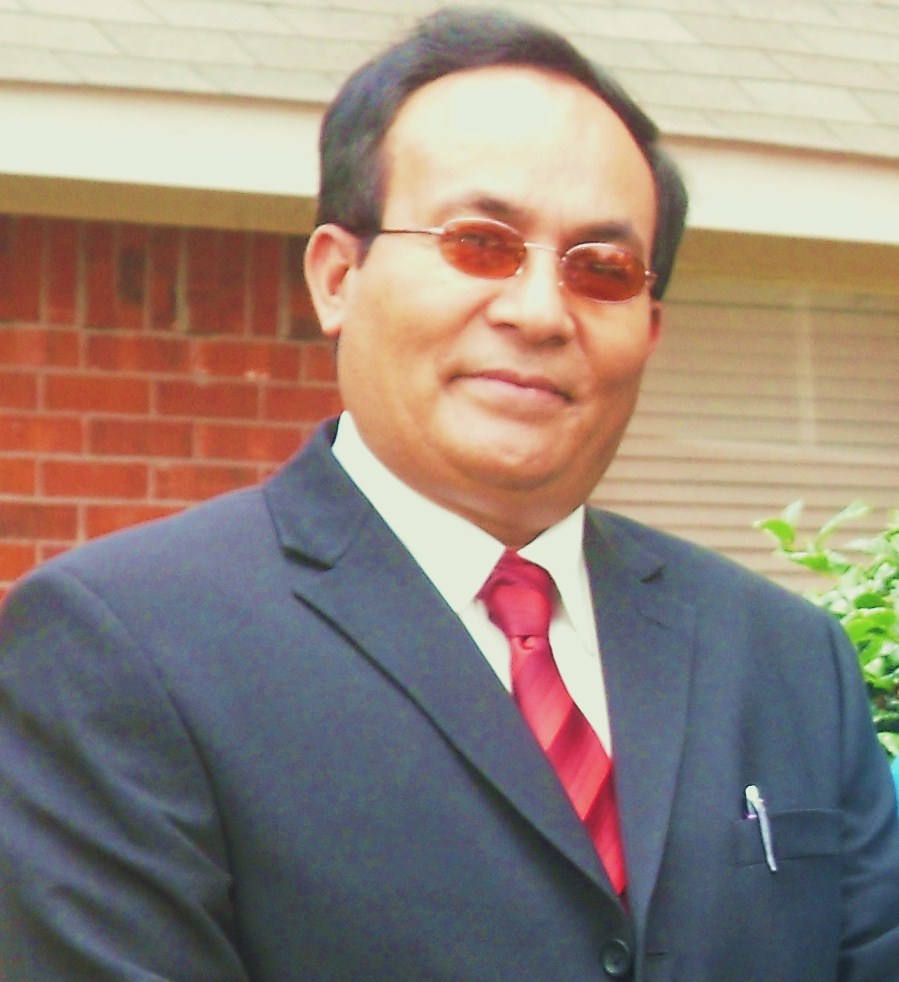
Writer is a Natural Rubber Scientist, awarded by Nepal Academy of Science and Technology - 2011. He is an active Member of American Society of Horticultural Science, Association for the Advancement Industrial Crop and American Forest. He is the Founder Executive Director of Institute of Rubber and Jatropha Research-Nepal, registered in Texas, USA. You can reach him at [email protected]
Tags:
Category: