

Tree speciesFungus nameDisease...
13Feb

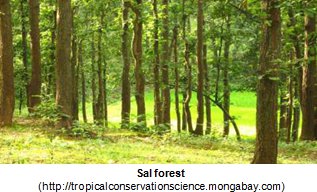
Sal (Shorea robusta) is a dominant tree species in the terai (southern flat lowland) of Nepal. It is common up to 1000 m. Sal is a deciduous species and attains height up to 45 m. It is the main source building timber and also used as fuelwood and fodder (Jackson, 1994).
Sal covers over 11 million ha in India, Nepal and Bangladesh (Gautam et al., 2005). Sal forests cover 110 000 ha in Bangladesh, 10 million ha in India (Tewari, 1995) and need to update for Nepal !! It regenerates very well in Nepal but heavily damaged by grazing and frequent forest fires.
Sal Borer: An Introduction
The major devastating insect pest of Sal known as Sal heartwood borer, Hoplocerambyx spinicornis, belongs to the family Cerambycidae. This beetle, popularly known as the longicorn beetle, is a dreaded woodborer. It is an inhabitant (or is endemic) of the whole of the Sal tract including the dipterocarp forests of the Philippines and Borneo (Beeson, 1941). The trees of all sizes and ages were attacked in the epidemic, though, the preference was for trees of 60-120 cm. girth class. The sap can attract insects from a distance of 2 km (Prakasam et al., 2000).
These insects are always present in the Sal forest in low densities. The infestation of Sal borer is considered to be epidemic when the trees affected are more than 1.0 percent of the total growing stock of the trees. The population sometimes explodes during favorable conditions as:
- Generally more humid conditions
- Temperature close to 27-28 degree Celsius
- Homogeneous, even aged (older), dense Sal stand
- Stressed trees are more susceptible to attack (nutrients, climber load, suppressed trees etc)
Life Cycle of Sal Borer
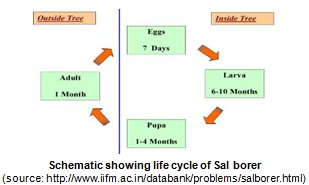
The life cycle of the Sal borer consists of the following stages: 1) Eggs, 2) Larvae or grubs, 3) Pupae, 4) Beetles.
Eggs
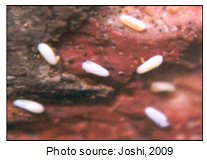 Each female beetle lays about 400 eggs, generally on the bark of the dead or dying trees 7-9 days after the emergence. The eggs are white-creamed color, about 4 mm long. The preferred site of oviposition are the underside of logs on the ground and the shady side of the trunk and branches of standing trees. The viability of eggs varies from 75 to 100 per cent depending on weather conditions. The egg laying is correlated with humidity. At 55% relative humidity, there is no oviposition. Oviposition is only above 55% r. h. In dry conditions, the eggs are killed due to desiccation and very high humidity invites attack of some fungal hyphae.
| Humidity % | 55 | 61 | 66 | 78 | 89 | 91 | 100 |
| No. of eggs | 0 | 42 | 83 | 273 | 416 | 465 | 40 |
Larvae
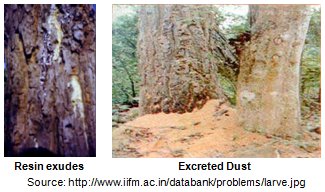
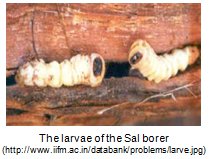 The white grubs hatch forms the eggs and feed under the bark. They soon enter the sapwood and finally the heartwood by the end of November. The sapwood exudes a sap (resin) sometimes kills larvae. Weak and diseased trees and broken/felled trees are more attacked. The larvae feeds on sapwood throughout their life. The full grown grub is about 7.5 cm in length. It excretes a lot of wood dust that accumulates into heap near the base of the tree. It ultimately leads the tree to girdle and dry up. Through the winter and ensuring hot weather the grubs bore tunnels in the heartwood. It then develops a pupae chamber, In the final stage the larvae shuts itself in by a partition of calcium carbonate and long wood fibers loosely packed.
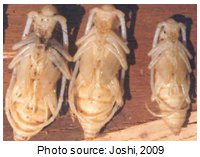 Pupae
Pupae
Pupation occurs in pupal chamber. It begins from February and continues till April. After 2-3 weeks of pupal period, immature beetles of Sal borer develop and wait inside the pupal chamber for the emergence till the monsoon arrives.
Beetle
Dark brown beetle in color, about 2 - 6.5 cm in size. 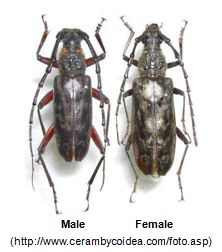 It has long antennae. The antennas of male are relatively longer than the body while the female is shorter than her body. It appears annually with the start of Monsoon. The emergence is largely complete when the cumulative rainfall is about 900 mm during early monsoon.
Factors Responsible for Outbreak
- Crop Age, Health, etc.: Saplings and young sal trees less attacked. Weakened trees due to lopping, girdling, fire, frost, infested by heart rot or any other disease and over matured are more prone to the attack
- Site Condition: The site conditions including soil type are very much essential for the vigorous growth. Vigorous sal trees are less attacked by the borer.
- Weather Conditions: Low atmospheric humidity due to abrupt cessation of rain stops egg laying and grub mortality to some extent due to desiccation.
- Forest Hygiene: Odour from broken sal trees during monsoon attracts beetles from long distances . Lops and tops of fallen sal trees, which provide hiding places to beetles
- Natural Enemies: The grubs sometimes die due to the attack of fungi – Beauveria bassiana and Metarhizium anisopliae. Brachypternus benghalensis feeds on young grubs feeding on sapwood. The jungle crow, Corvus macrorhynchos feeds on the beetles in Sal forests as well as in sal depots.
Extent of Damage by Borer
In 1996-97, 60 thousand out of the 180, 000 trees were identified and marked as infested. The forest department had cut nearly 600,000 trees by 15 January 1998. By the end of 1999 about 3000000 trees have been felled.
| Year | No. of Insects caught and killed | Country | Remarks |
| 1996 | 210,000 | India | 0.50 Paisa/insect head (=75 cent/head) was paid to farmers by Forest Department. |
| 1997 | 12,00,0000 | India |
| Tree Damage (no.) |
Average timber/tree (cu. m.) |
Costs per unit (Euro) |
Total timber damage (cu. m.) |
Total cost (Euro) |
Remarks |
| 36,00000 | 1.0 | 550 Euro | 36,00,000 | 198,00,00,000 | One third of the timber price is achievable (assumption) |
Control Measures
A. Preventive measures
- Maintain the stand density
- Control burning
- Avoiding the tree damage: Grazing and other biotic interference in sal forests should be minimized as far as possible.
- Burning of debris and stumps after harvesting of trees.
- Sal timber depots should be away from the Sal forests.
B. Remedial measures
- Trap tree operation: few medium sized trees should be felled every year during the monsoon (especially June- July) and their bark should be smashed. The fresh smell attracts the insects from the distance of up to 2 kms.
- Cutting affected trees: Felling and removal of affected trees away from the sal forests (identified by the large amount of yellow resin oozing out of the bark and heap of wood dust at the base of the trunk).
- Stacking of infested timber in depots 5 km away from Sal forests
- Diseased or dying sal trees, wind-fallen trees, insect (borer) attacked, felling refuse, etc. should be disposed off during winter-summer before onset of monsoon every year.
Conclusion
Sal borer is highly destructive insect pest to the Sal. The tree vigorosity should be maintained as the pest attracts to the inferior trees at the beginning. Leaving logs or parts of dead trees on the ground should be avoided. Controlled forest fire maintains its population by killing the eggs in the bark. Insect trap and killing method is most effective remedial method to check its population. The flight behavior, dispersal of the pest, its biological control measures etc. should further be studied to protect trees from the borer.
References
- Beeson, C. F. C., 1941. The ecology and control of the forest insects of India and the neighbouring countries. Part one: The ecology of forest insects. Dehra Dun, Vasant Press, 767 p.
- FAO 1985 Dipterocarps in South Asia. FAO Regional Office for Asia and Pacific, Bangkok.
- Jackson, J. K. 1994. Manual of Afforestation in Nepal. Forest Research and Survey Centre, Kathmandu, Nepal
- Joshi, K. C., 2009. Biology, life history of Sal heartwood borer, factors responsible for ourbreaks and its management-An Updated Information, Forest Entomology Division, Tropical Forest Research Institute, Jabalpur, India. (source: http://www.frienvis.nic.in/Bulletinwork/EFB-2009-I.htm)
- Gautam, Krishna H., & Devoe, Nora N., 2005. Ecological and anthropogenic niches of sal (Shorea robusta Gaertn. f.) forest and prospects for multiple-product forest management – a review. School of Forestry, University of Canterbury, Private Bag 4800, Christchurch, New Zealand
- Prakasam, U., A. P. Dwivedi and Anil Oberoi. 2000. Heartwood borer epidemics in central india: a threat to shorea robusta forest ecosystem. http://www.fao.org/DOCREP/ARTICLE/WFC/XII/0739-B1.HTM
- Tewari, D.N., 1995. A Monograph on Sal (Shorea robusta greatn. F.), International Book Distributors, Dehra Dun. 277 p.
- http://www.iifm.ac.in/databank/problems/salinfo.html
Category: