

PRESS RELEASE: Research Project on...
23Aug
Posted by rajeshsada
Kathmandu, 16-20 August 2010. The process of increased urbanization in South Asia has been a matter of concern for academicians, policy makers as well as civil society groups. It is being sustained mainly through acquisition of agricultural lands from the peripheral areas. The concern largely emanates from increased stress on natural resources especially water, for the poor and vulnerable populations living at the edge of large cities, popularly referred to as ‘peri-urban’ which faces threat of land acquisition and iniquitous water uses by different users. This threat is likely to be accentuated in the future due to the impact of climate change that will result in altering the water availability patterns in terms of uncertainty in water supply, diminishing access, growing water conflicts and hence, erosion of social capital.
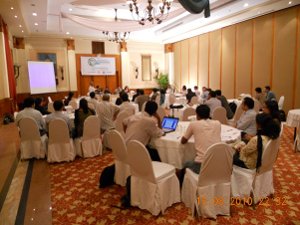
 Nepal Engineering College, Kathmandu held an inception workshop from August 16-20 to discuss the above issues which is part of a project on Water Security in peri-urban South Asia: Adapting to Climate Change and Urbanization. The main objective of workshop was to develop understanding as peri-urban water issues and emerging water security concerns in the four locations of the study and get insights into the works undertaken, including those currently underway and use them in defining the scope of the intended three years long study on the issue.
The project, coordinated by SaciWATERs, South Asian Consortium for Interdisciplinary Water Resources studies is supported by IDRC, The International Development Research Center, Canada.
 |
This project will span over a period of three years and will involve institutions from Nepal, Bangladesh and India who will collaborate as partners in the project to document how urbanization and climate change affects water availability in selected peri-urban locations in these countries. The project will identify the groups that are particularly vulnerable and examine how they adapt to these changes, as well as how their adaptive capacity can be improved through technical and institutional interventions. It also seeks to bring together a large number of stakeholders who have the potential of influencing these issues. This is all the more important because peri-urban areas tend to be neglected both by urban and rural authorities- since some of their problems fall under the mandate of neither. The project involves elements of research, stakeholder participation as well as capacity-building of target groups-both government and civil society- in meeting these challenges more effectively.
As a part of the inception workshop, NEC, the host organization for the project in Nepal discussed the ways and means to have greater water security for the poor in urban and peri-urban locations in Kathmandu. The workshop was attended by about 50 participants from the government, civil society groups, academics and researchers.
Delegates from the four project partner institutions from the three south Asian countries India, Nepal and Bangladesh and the supporting institute International Development Research Center (IDRC), through its regional Office for South Asia and China (SARO) based in New Delhi expressed their appreciation and pledged support for the regional initiative being coordinated by South Asia Consortium for Interdisciplinary Water Resources Studies (SaciWATERs), Hyderabad, India and executed in association with the Institute of Water and Flood Management (IWFM), Bangladesh University of Engineering and Technology (BUET), Management Development Institute (MDI), Gurgaon, India and Nepal Engineering College (nec), Kathmandu for improving the understanding on the water related vulnerability, adaptation and resilience of different social groups in the context of climate change in peri-urban locations of the selected sites.
 |
The first day of the workshop was intended on disseminating the information about the research in which experts, academicians, policy makers as well as civil society and the researchers presented their research papers on water concerns. They outlined the emerging issues, gaps and challenges in the region and discussed ways for addressing the implication of growing urbanization and ensuing water uncertainties.
The program session was planned into three sessions with a panel discussions and chair persons remarks. The first session chaired by Prof. Dr. Hari Krishna Shrestha and presentations from Dr. Anjal Prakash from SaciWATERs, Hyderabad, India on the objectives of the workshop followed by the presentation of Dr. Sara Ahmed from IDRC, New Delhi on the relevancy of the project in the context of IDRC’s portfolio provided the overall project overview.
Dr. Sara Ahmed chaired the second session which emphasized on the perspectives of peri-urban issues and water security. Dr. Mahendra Subba, DDG, Department of Urban Development, Ministry of Physical Planning and Works, Government of Nepal highlighted on regulatory frameworks of urban environmental planning and infrastructure development in the Nepalese context. This was followed by the analytical presentation from Prof. Dr. Hari Krishna Shrestha on the history of Water Management Institutions of Nepal and their role in adapting to water scarcity. Proceeding the session, Mrs. Lajana Manandhar from LUMANTI also shared her experiences of water and housing security initiatives for low income and informal groups in numerous urban and peri-urban areas of Nepal.
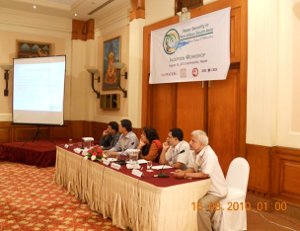
This session called for a short press meeting attended by Dr. Sara Ahmed representing IDRC, Dr. Anjal Prakash from SaciWATERs, Prof. Shah Alam Khan from BUET and Prof. Dr. Hari Krishna Shrestha and Prof. Ashutosh Shukla representing nec.
The final session chaired by Prof. Shah Alam Khan included three more interesting presentations started by a well acclaimed interdisciplinary analyst, Mr. Dipak Gyawali on the concept of Desakota as a tool for urban environmental planning and the other on the growing issue of rural-urban water transfer and perspectives of flourishing water tanker business by Mr. Dibesh Shrestha, student from nec. This was followed by the presentation of Mrs. Sabitri Tripathi, Associate Professor from nec. She shared the outcomes of DFID supported research project on the development of appropriate safe drinking water supply and sanitation system for slum dwellers and squatters in Nepal.
Following this was the critical discussions among the panel and the participants. Concluding the program, Prof. Dr. Hari Krishna Shrestha acknowledged the experts and participants for their valuable time and suggestions for carrying the research forward.
From the second day on to the next four days, the workshop was an internal meeting only among the project partners with intention to develop a shared understanding of the conceptual and methodological issues in the design and execution of the project. On the fourth day of the workshop, the core team of the project had visited field at Matatirtha for understanding the water security issues in peri-urban areas.
The workshop was concluded by keeping some milestone to be achieved within first six-month period.
For more information:
Please Call – Prof. Ashutosh Shukla, Professor, Nepal Engineering College – Ph 9841743032 or Rajesh Sada, Project Coordinator, Water Security Project in Kathmandu – Ph 9751041822.
Category: