
Conservation Science, a new journal in...
Problem - incredible manipulation by human being
- Human foot print is every where
- More than 80% of the globe bear our footprint
- 90% of the fertile land used by human
- Overall somewhere between 20-32% of earth resources are for human use.
- Around 60% of freshwater production
- It would take 4 earths to support the world‟s population at the current level of consumption level of US citizens.
 The land available to each person on Earth has been “shrinking” :
- 1900 - 7.91 ha ,
- 2005 - 2.02 ha and
- 2005-2050 – 1.63.
- Dramatic decline of abundance of other species
- We are living in the in a time of unprecedented mass extinction.
- Human beings are currently causing the greatest mass extinction of species since the extinction of the dinosaurs 65 million years ago. If present trends continue one half of all species of life on earth will be extinct in less than 100 years, as a result of habitat destruction, pollution, invasive species, and climate change.
According to IUCN Report
- 21 percent of all known mammals
- 30 percent of all known amphibians
- 12 percent of all known birds
- 28 percent of reptiles
- 37 percent of freshwater fishes
- 70 percent of plants
- 35 percent of invertebrates assessed so far are under threat
Why study Conservation Biology?
In the end we will conserve only what we love, we will love only what we understand and we only understand what we are taught” (Baba Dioum)
What is conservation biology?
Conservation driven by religious and spiritual reasons is as old as human civilization
- Formalized in 80s but evolved over time
- Conservation science is response of scientist to ecological crisis
- The science of the protection and management of biodiversity
- "Discipline with a deadline” or "crisis discipline",
- Save from sixth mass extinction
- Bad for biodiversity is certainly bad for human wellbeing.
- Equity - inter generational equity and efficiently – resource should not be used wastefully.
- In 2008, 18,225 new species of animals, plants, algae, fungi and microbes were found (http://fcmdsc.wordpress.com/2010/06/02/top-10-new-species-discovered-in-200/)
- Over 350 new species in the Eastern Himalayas over the past ten years (1998-2008). (Source: Eastern Himalayas -Where Worlds Collide)
- Between 1999 and 2009, more than 1,200 new species of plants and vertebrates were discovered in the Amazon biome – or one new species every 3 days.
Four key philosophies
Current conservation efforts represent a more balanced view than the extremes
| John Muir | Pinchot | Leopold | Wilson |
|
|
|
Ecology approach E.O. Wilson‟s four postulates
|
| Enjoy | Use | Live/Survive with | Manage it |
Biodiversity is more than species
- Biodiversity includes diversity within species populations (genetic variation); the number of species, and the diversity of ecosystems.
- Biodiversity is more than the sum of the parts
- Biodiversity is not static but constantly changing
- 99% of the species that ever lived have gone extinct
Goals of conservation biology
- To investigate human impact on biological biodiversity.
- Concerned with loss of biodiversity, not just loss of species
- Fundamental loss of resources in genetics, species, community attributes and ecosystem properties
- To develop practical approaches to prevent extinction of species maintenance of biodiversity, ecological and evolutionary processes
- Developing compromises between conservation and human needs.
E.g. intelligent and informed management decisions
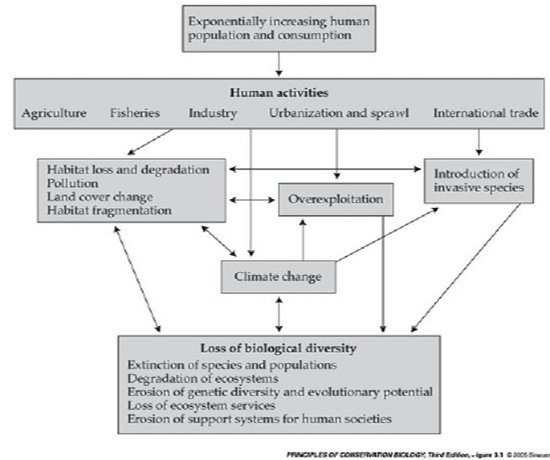
Current Major Threats to Biodiversity
- Habitat Related (Loss, Degradation, Fragmentation)
- Pollution
- Overexploitation
- Invasive Species
- Anthropogenic Climate Change
- Disease
- Synergistic Effects of Threats
Objectives of conservation biologist
Conservation biologists seek to maintain three important aspects of life on Earth:
- the natural diversity found in living systems (biological diversity);
- the composition, structure, and function of those systems (ecological integrity);
- and their resiliency and ability to endure over time (ecological health)
Diversity and ecology
- Biological diversity is a measure of the diversity of all life at all levels of organization.
- Ecological integrity is a measure of the composition, structure, and function of biological systems.
- Ecological health is a measure of a biological system's resiliency and ability to maintain itself over time.
Conservation requires a combination of many different strategies
- Protect species at risk of extinction.
- Designate ecological reserves.
- Lessen the magnitude of human impacts on natural systems.
- Restore ecosystems that have been degraded.
- Augment populations with individuals raised in cultivation or captivity.
- Control the number of individuals harvested in nature.
- Prevent the establishment of non-native species, and eliminate non-native species that have become established.
- Understand and participate in the policy-making process.
- Educate others about the importance of conservation.
Conservation Biology
Conservation Biology is not
- Environmentalism
- Forestry/Game Management - managing small range of species for economic objectives
- Biological Preservation – fossilizing
Conservation Biology is
- Is the long-term preservation of the entire biological communities as its primary consideration with economic factors often a secondary consideration?
- Attempts to keep normal evolutionary processes working within a functioning ecological setting.
Conservation Biology - Guiding Principles
- Principle 1: Evolution is the basic axiom that unites all biology
- Take evolution into account when trying to develop solutions to ecological problems
- E.g. the genetic composition of populations is dynamic. Thus, it is not the goal to stop the changes, but rather ensure they have the ability to change and adapt
- Principle 2: the ecological world is dynamic and largely non-equilibrium
- At some spatial or temporal scale, all systems become dynamic
- It is important to remember that just because systems are in non-equilibrium, that does not mean species are either unpredictable or ephemeral
- Principle 3: human presence must be included in conservation planning
- Any conservation efforts that do not account for humans (either as the cause of the problem or part of the solution) are not possible.
- Human being have been an integral part of earth‟s biodiversity for more than 10 000 yrs
- Indigenous people have history of interaction with other organism in areas of conservation interest.
Conservation Biology:
- A value-laden science: Science is value-free
- A Science of Eternal Vigilance
- Even protected areas may not remain protected
- A science with an evolutionary time scale
- Traditional resource management typically attempts to maximize the current yield
- The goal is to simply retain the diversity of structure and function, forever
- A discipline responding to an immense crisis
By definition, information is frequently incomplete and sometimes missing
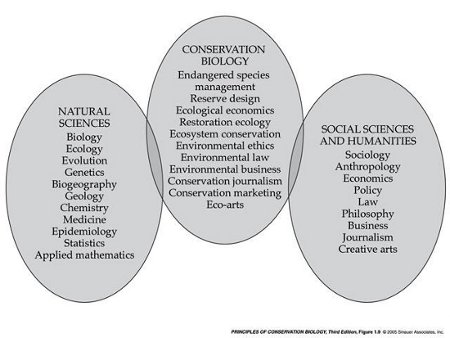
Conservation Biology – an integrated science
Key conservation approaches: En -situ and ex- situ
- Gene and species conservation
- Ecosystem approach
- Landscape and eco-region approach
- Ex-situ conservation
Conservation Biology –in summary
- Current conservation efforts represent a more balanced view than the extremes
- Merging pure and applied science
- Unification of diverse field: sociology, economy, policy etc.
- Broader view of conservation: all biodiversity – local to global
- Precautionary principle or „First, do no harm”
- Acknowledging human role
Tags: