
Links between faiths and conservation...
- Biodiversity are under threat, from habitat loss and degradation, invasive species, climate change, pollution and over-exploitation
- Protected areas are an important tool for biodiversity conservation.
- Biodiversity patterns are not uniformly distributed. Need to know where to preserve and manage it!
- The design of protected areas and reserve networks should foster representation of biodiversity and its persistence.
- Reserves need to be sited efficiently to represent biodiversity.
- Size, shape and connectivity of reserves and relationship with the surrounding landscape matrix are essential considerations for biodiversity persistence.
Maintaining biodiversity over time
- Population persistence (viability)
- Maintaining ecological processes E.g. migrations
- Maintaining evolutionary processes
- Potential for adaptation within populations (genetic diversity)
- Selecting areas where rapid speciation is occurring
- Response to climate change
Size and shape
Larger size -->
- More species (interactions, functions), S-A relationship
- More habitats (interactions, functions)
- Larger populations –
- Protects vulnerable species
- Area demanding: large-bodied, high-tropic level, rare
- Habitat specialists (if habitat included)
- Species requiring multiple habitat types
- Shape --> Reduced edge/area ratio, edge effects
- Disturbance regime: maintenance of disturbance-generated patch heterogeneity
- Includes whole functional units
- Includes whole environmental gradients
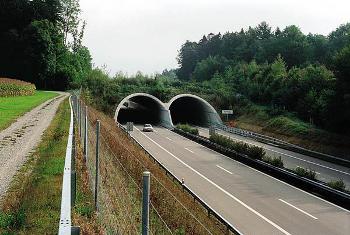 Connectivity
- Isolation is a key factor causing loss of species from reserves
- Preventing gene flow, maintenance of genetic diversity
- Reducing recolonization following extinction (rescue effect)
- Preventing access between summer/winter grounds for migratory species
- Preventing access to multiple habitat types needed for different life stages
- Preventing response to global warming
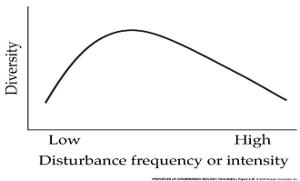
Disturbance Regime
- Disturbance promotes habitat heterogeneity
- By resetting successional sequence in parts of the landscape
- Creating patchiness in the landscape which is determined by the temporal and spatial scale of the disturbance(s)