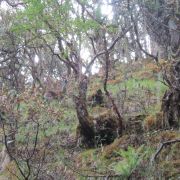

Musk deer (Moschus chrysogaster), one...
This study was carried out in Sagarmatha National Park (SNP) at Phortse during September 2005 to explore the population status and distribution of musk deer, to outline the threats and to determine the mitigation measures for its conservation. Field data were collected through interview, group discussion, sample plot survey and transect walk.
Musk deer are distributed between elevations 3000-4200m in SNP however they sometime can be observed to 2800m (Jorsale). They are distributed in Tasinga, Chhuwa, Lausasa, Seluwa, Kyanjuma, Phungithaga, Thulo Odar, Shyangboche (3720m), Debuche, Omaka, Milunga, Yaranga up to Pangboche (3930m) on the way to Island Peak; Mongla (3973m), Phortse Thanga, Phortse Pakha, Phortse up to Dole (4200m) on the way to Gokyo; and Phurte up to Pare up the Thamo (3493m) on the way to Gomo or Mokyo. Twenty-five musk deer has been found in Phortse and the ratio was 2:5 (male:female). Assuming that 25 gm of musk can be extracted from 1 deer per year, a total of 175 gm of musk can be obtained from 7 male deer in Phortse.
Despite the shy and solitary nature of animal, the musk deer in SNP can be seen frequently and closely; they can be seen at a distance of 10 m or even closer. They prefer their bedding sites under the big stones. Each musk deer use a common latrine and when the droppings are huge, the deer covers it with debris and changes the latrine.
Poaching is the major threat to musk deer in the area. Studies from 1992 to 2005 reveal that 64% of the illegal activities is related to musk deer poaching. However, threats from grazing, timber and firewood collection, land slide and construction are also active. Tourism and predators have not affected the population of musk deer significantly. Despite the poaching threats, the local people are very aware of protecting the forest and wildlife. The local people of Phortse have been protecting the forest for at least 150 years by a Shigi Nawa system. In addition, 15 anti-poaching units, which involve local people, have been established to protect the wildlife species from park side. In spite of the legal and policy constrains, Phortse is suitable area biophysically and socio-economically for musk deer farming.
Citation:
Rajchal, R. 2006. Population Status, Distribution, Management, Threats and Mitigation Measures of Himalayan Musk Deer (Moschus chrysogaster) in Sagarmatha National Park. A Report submitted to DNPWC/TRPAP, Babarmahal, Kathmandu, Nepal. Institute of Forestry, Pokhara, Nepal.
| Attachment | Size |
|---|---|
 pub_musk_deer.pdf pub_musk_deer.pdf | 1.96 MB |