
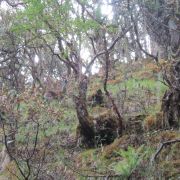
The Himalayan musk deer (Moschus...
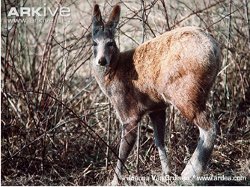 |
| (By: Srijana Shrestha) |
Classification
Kingdom: Animalia
Phylum: Chordata
Class: Mammalia
Order: Artiodactyla
Family: Moschidae
Genus: Moschus
Nepali Name: Kasturi Mriga
English Name: Musk Deer (Himalayan Musk Deer)
Scientific Name: Moschus chrysogaster leucogaster
Synonyms: Moschus cacharensis, Moschus chrysogaster leucogaster, Moschus saturatus, Moschus zhangmu
Conservation Status
IUCN: Endangered
CITES: Appendix I
NPWCA, 2029: Appendix I
Introduction
- Musk Deer is a mammal of higher Himalaya so it is also called Himalayan musk deer.
- Musk deer ‘Moschus chrysogaster’ is one of six deer species of Nepal and in Asia; it is distributed in Afghanistan, Bhutan, China, India, Myanmar, Nepal, and Pakistan.
- In Nepal, it is found in the Annapurna Conservation Area (ACA), Kanchenjunga Conservation Area (KCA), Sagarmatha, Langtang, Shey Phoksundo, Rara, Khaptad and Makalu Barun National Parks and Manaslu Conservation Area, where a major problem is poaching.
- In these areas, they are distributed in Alpine forest and the vegetation is oak, fir, rhododendron, blue pine, juniper, grass, lichens and scrub between elevations of 2,200 to 4,300 meters (7,250-14,200 feet) on the eastern and southern edge of Tibet and the southern slopes of the Himalayas.
- M. chrysogaster usually lives in forests with moderate to steep slopes. Himalayan Musk deer are essentially solitary animals having 12-20 year life span.
Biology
- Color : Dark brown
- Physical Shape: Large ear, short tail, no horn, no antler, male has canines (6 – 10 cm).
- Body Length: 86 – 100 cm, shoulder Height: 51 – 53 cm, tail Length: 4 – 6 cm and weight : 10 – 18 kg.
- Breeding Season: November – December
- Gestation Period: 178 – 198 days
- Young per Birth: Usually one
- Weaning: 3 – 4 months
- Sexual Maturity: 16 – 24 months
- Life Span: 12 – 20 years
- Musk Male contains musk gland (about 10 gm musk pod); can be harvest an average of 25 gm per year
Description
- Musk deer inhabit steep, forested or shrub-covered slopes, mainly in the sub-alpine zones of mountain regions. Musk deer are of dark brown color and their over with coarse and brittle hair.
- Musk deer movement appears more like jumping than running. Their toes are large for their body size and can be spread to find secure footing in mountains and on snow. Their coat is thick and includes brittle guard hairs. Individual hairs contain air-filled cells for better insulation.
Habitat and Range
- The characteristic landscape for Musk deer constitutes mountains covered with mixed forest especially places where precipitous cliffs abound.
- Use of the habitat depends upon the availability of cover, food and other factors: Musk deer are very shy and solitary animals that may not become active until dusk.
- The Himalayan musk deer inhabits meadows, shrub lands and fir forests on high altitude of 3,000 to 4,500 meters where temperate climate prevails.
Threat
- The primary threat to the Himalayan musk deer is hunting for musk; a highly-desired product has been used in perfumes and traditional medicines for over 5,000 years.
- Animals are indiscriminately caught using snares, and although only adult males produce musk, both females and juveniles are also caught, with between three and five deer killed per harvested musk pod.
- In some regions the Himalayan musk deer may also be hunted for its meat, while its habitat is threatened by encroaching pastoral farming.
Reproduction
- The relatively high reproductive rate of musk deer has probably been an important factor in preventing extinction of the species. Musk deer breed seasonally.
- The mating season is November-January, depending on area altitude and region. Soon after the first snow fall in November, the females start to exhibit the sign of heat and this lasts from November to March.
- Approximately, at the age of 2.5 years the male is capable of performing more than three copulations a day, one cycle of copulation takes 5-10 minutes.
- The musk that the males secrete with urine is much more concentrated during the mating season, appearing dark pink or red on snow.
- The birth weight of Musk deer varies between about 400g and 600g, depending on the species.
- In their first two months, the young Musk deer, like all deer species, are “nursed offspring” concealed in the undergrowth and suckled by their mothers.
- Female Musk deer are capable of breeding after their first year.
Food Preference
- Musk deer feed on herbaceous and woody plants, leaves, flowers, twigs, lichen, moss, shoots and grass. More than 130 plant species are consumed by musk deer.
- In the winter, arboreal lichens and some terrestrial bushy lichens make up about 70% of the contents of a musk deer's stomach (by weight). In the summer, herbaceous plants are the main diet.

