

Studies on the relationship between...
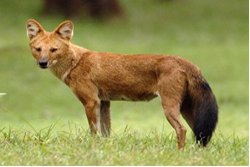 |
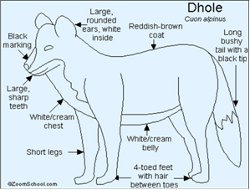 |
| ( By : Prabhat Pal) |
Classification
Kingdom: Animalia
Phylum: Chordata
Class: Mammalia
Order: Carnivora
Family: Canidae
Subfamily: Caninae
Genus: Cuon (Hodgson, 1838)
Binomial name: Cuon alpinus
IUCN category: Endangered
English name: Asiatic wild dog, Indian wild dog, red dog
Sub-species
- C. a. alpinus (east of eastern Sayans, East Russia). Thick tawny red coat greyish neck and ochre muzzle.
- C. a. lepturus (south of Yangze River, China). Uniform red coat with thick underfur.
- C. a. dukhunensis (south of the Ganges, India). Reddish coat, short hair on the paws and black whiskers.
- C. a. adjustus (North Myanmar and north-east India). Reddish brown coat.
- C. a. primaevus (Himalayan Nepal, Sikkim and Bhutan). Longer redder coat than C. a. dukhunensis, long hair on paws.
- C. a. laniger (Kashmir and southern Tibet). Full, yellowish-grey coat, tail not black but same colour as body.
- C. a. hesperius (East Russia and China). Long yellow tinted coat, white underside and pale whiskers.
- C. a. fumosus (West Szechuan, China and Mongolia). Luxuriant yellowish-red coat, dark back and grey neck.
- C. a. infuscus (South Myanmar, Malaysia, Thailand, Laos, Cambodia and Vietnam). Relatively uniform brown coat.
- C. a. sumatrensis (Sumatra, Indonesia). Short red coat and dark whiskers.
- C. a. javanicus (Java, Indonesia). Short, bright red coat.
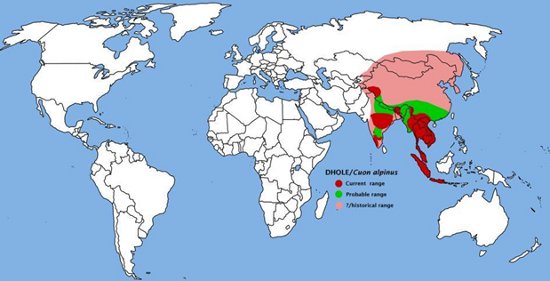
Habitat
- wide variety of vegetation types
- Primary, secondary and degraded forms of tropical dry and moist deciduous forest;
- Evergreen and semi-evergreen forests;
- Dry thorn forests;
- Grassland–scrub–forest mosaics; and
- Alpine steppe (above 3,000 m).
- But not recorded from desert regions.
- Important influencing factors
- Availability of medium to large ungulate prey species, water, the presence of other large carnivore species, human population levels and suitability of breeding sites (proximity to water, presence of suitable boulder structures and sufficient prey).
Food and Foraging Behavior
Food
- Varies throughout their range.
- Beetles, rodents, and birds have all been recorded
Among Dhole prey items (e.g., Adams 1949; Davidar 1975);
- Dholes hunt mainly vertebrate prey, with a preference for medium to large ungulates.
- Samber (Cervus unicolor), Chital (Axis axis), Barking Deer (Muntiacus muntjak) and Wild pig (Sus scrofa)
Foraging behavior
- Communal hunters, packs may up to 30 animals, generally 10.
- Also hunt alone or in pairs, taking smaller prey such as infant deer or hares.
- Can hunt at any time of the day or night.
- Certain individuals lead the chase or taking the first grab at the prey and pack members communicate their whereabouts with whistles and yelps, and cooperate.
- They eat quickly (e.g., up to 1kg per dog in 4 minutes; Johnsingh 1983),
- They prefer to kill their own prey, but sometimes steal the kills of other species, or scavenge from old kills.
Social behavior
- Dholes usually live in packs of 5–10 individuals.
- Groups have a strong hierarchical structure, with a dominant male and female who are the main, or sole, breeders.
- In Bandipur, India, Johnsingh (1983) reports a home range size of 40 sq.km and Venkataraman et al. (1995) found ranges of 54 and 83 sq.km in Mudumalai.
- Broad and unusual vocal repertoire that includes whines, mews, and squeaks (Fox 1984).
- Growls, growl-barks, chattering calls, and screams are used as alarms to alert other pack-mates to danger (Johnsingh 1982).
- A repetitive whistle-like contact call may allow dispersed pack members to identify one another and to re-group (Durbin 1998).
- Group cohesion in this way is likely to be highly adaptive in areas with other large predators.
Reproductive behavior
- Dholes give birth once a year and have a gestation period of about nine weeks (Sosnovskii1967).
- Mating occurs between November and April (dry season) in India, with a peak during December and January (Davidar 1973; Venkataraman 1998; Johnsingh 1982).
- Litter sizes vary dramatically, even within the same pack in different years (e.g., up to 8, and 5–10, for two packs in Mudumalai; Venkataraman et al 1995).
- Pups are weaned by about 6–7 weeks (L. Durbin et al. unpubl.).
- Dholes reach adult size by about 15 months.
- Venkataraman (1998) states that female dholes breed for the first time at three years.
Threats
- Depletion of the dhole’s prey base
- Protected areas of Cambodia, Laos, and Vietnam, lower level of ungulates.
- Only a few of the largest wildernesses support nearly intact species assemblages and even in these, the larger species (Bos spp., Cervus spp., hog deer Axis porcinus) are very rare.
- In north-east India, prey densities are very low in protected areas with dholes.
- Habitat loss and transformation:
- Laos and Cambodia; Vietnam (hardly 50 km2 area remains)
- Also serious threats to dholes in South Asia,
- Disappearance of Dholes from many of the forested tracts in India has been attributed in large part to loss of habitat.
- Persecution by cattle graziers through poisoning, shooting, trapping, and killing of pups at dens
- Competition with other species including feral domestic dogs for prey species
- Disease and pathogens (transmitted by feral and/or domestic dogs, e.g., mange, canine distemper, parvovirus and rabies. significant threat in South Asia, and probably in parts of Indonesia)
Legal protection
- CITES – Appendix II (2003)
- Cambodia, the current wildlife decrees give the Dhole protection from all hunting.
- In India, protected under Schedule II of the Wildlife Act, 1972 (permission required to kill any individual unless in self defense or if an individual is a man killer).
- In the Russian Federation, dholes received the status of “protected animal” in 1974.
- In Vietnam, the Dhole is protected by Decree 18/HDBT (17/ 01/1992) and the amendment Decree 48/2002/ND-DP (22/ 04/2002) under category IIB, which limits extraction and utilization. However, the levels of extraction or utilization are not quantified
- Nepal-NPWC Act, 1973, Schedule-I (Protected)
Tags:
