The Alpine-Himalayan belt is one of the most complex and active mountain systems in the world. It stretches from the Mediterranean to the Tibetan Plateau and includes some of the world’s highest mountains, such as the Himalayas, the Alps and the Hindu Kush. This region is characterized by a diverse array of geological phenomena, including active volcanism, earthquakes, and glaciation. It is also home to some of the most complex plate boundaries in the world, with a wide variety of tectonic processes at work. In this article, we will look at what these plate boundaries are, how they interact with each other, and how they shape the landscape of the Alpine-Himalayan belt.
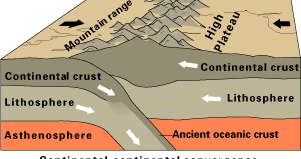
When two continental plates collide, the Himalayas are formed from a converging plate boundary. They both have the same density, so one does not slide below the other but crashes head on. As a result, the two plates that formed the mountains that we see today wererumped.
The lofty Himalayas, which stretch 2,900 kilometers along the border between India and Tibet and are a visible and dramatic example of plate-tectonic forces, are also among the most dramatic and visible creations of plate-tectonic forces.
What Kind Of Plate Boundary Forms The Alpine Himalaya Mountain Belt?
The Himalayan mountain range and Tibetan plateau were formed as a result of the collision of the Indian Plate and the Eurasian Plate, which occurred 50 million years ago and continues today.
Mountains are fascinating physical structures formed deep within the Earth by powerful forces. The lithosphere is constantly being shaped by convergent forces, divergent forces, and transform forces, from the highest mountaintop to the deepest ocean trench. When forces converge, compression is generated, resulting in mountain ranges and even volcanic activity. Divergence forces break up the lithosphere, resulting in oceanic ridges that are frequently found in the ocean. Shearing and folding of the lithosphere are also caused by transform forces. Every time one of these forces is at work, a majestic mountain rises up.
Unstoppable Forces: The Formation Of The Himalayas
The Himalayas, one of the world’s most impressive mountain ranges, began to form 40 to 50 million years ago when the Indian and Eurasian plates collided. Because the Himalayan mountains have similar rock densities, the plates crumpled and folded, pushing the rocks upwards, causing them to form the Himalayan mountain belt. This mountain range extends from Java and Sumatra to the eastern Mediterranean in a larger Alpine-Himalayan orogenic belt known as the Alpide belt, which spans more than 15,000 kilometers and is known as the Alpine-Himalayan belt. Mountain belts are formed by the movement of tectonic plates on the Earth, which are constantly at work. Mountains are formed by stretching and folding rocks, and compression, tension, and shear forces play a role in this process. When two continental plates collide, they press against each other, crumple, and fold until the rocks that support them come crashing down, forming a mountain range. This is one of the most fascinating aspects of the Himalayas, which have existed for millions of years and have been breathtaking to the eye.
What Are The Colliding Plates That Form The Alpine Himalayan System?
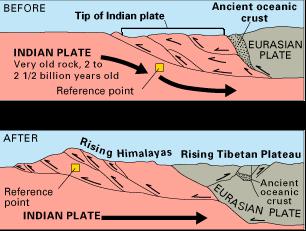
The Alpine-Himalayan System is one of the most significant orogenic belts in the world. It is a result of the collision between two major lithospheric plates, the Indian Plate and the Eurasian Plate. The Indian Plate was once part of the supercontinent Gondwanaland, while the Eurasian Plate was part of the supercontinent Laurasia. The two plates then began a northward collision toward each other, and this process is still ongoing. As they collided, the two plates created the Himalayan mountain range, stretching from Afghanistan to China. The Alpine mountain range, which stretches from Italy to Turkey, also formed from this collision. The Alps and the Himalayas, combined with the other mountain ranges in between, make up the Alpine-Himalayan System. This system is responsible for much of the world’s seismological and volcanic activity, as the two plates push against each other and produce powerful earthquakes and eruptions.
The Himalayan Impact: How Collision Changed The Earth’s Surface
The Himalayan Mountains were formed as a result of the collision between the Indian subcontinent and the Asian landmass, which resulted in the rise of the Tibetan Plateau and the continent-continent convergence that caused the Himalayan Mountains to form. The collision has resulted in significant climatic and environmental changes all over the world, as well as significant changes in the region and global climate. As a result, a wide range of mountains, valleys, and plateaus have formed from the Mediterranean to the Himalayas and beyond. Aside from some of the world’s highest peaks and glaciers, the Himalayas are home to a diverse range of plant and animal species. Furthermore, the collision has contributed to the monsoon climate of the region because the Indian Ocean’s air masses are forced upwards as the Himalayas rise. It is a major source of freshwater for China, India, and Nepal, and is an important contributor to the formation of the Asian monsoon system. The collision has had a significant impact on the region’s residents, with an increase in migration and a growing number of environmental challenges.
Where Do Alpine Himalayan Belt Earthquakes Occur?
Earthquakes occurring in the Alpine-Himalayan belt are the result of two large tectonic plates colliding. This collision of the Eurasian and the Indian plates is responsible for the creation of the world’s tallest mountains, the Himalayas and the Alps. While most of the earthquakes occur in the Himalayas, they can also be felt in the other mountain ranges, like the Alps. The seismic activity in this area is usually shallow and of moderate magnitude, often not felt by people living in the region. Earthquakes in this belt can also occur in other regions, such as the Central Asian Mountains and the Caucasus.